
Amélie
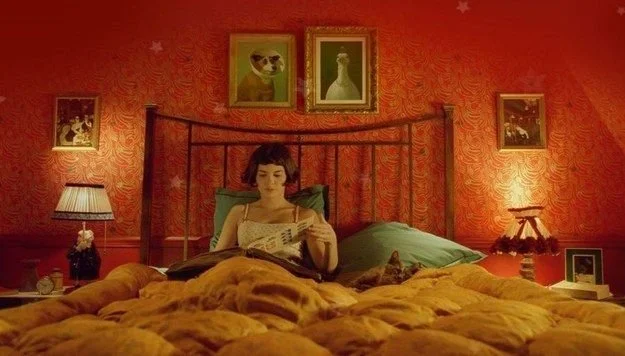
Film Title: Amélie (Le Fabuleux Destin d'Amélie Poulain)
Year: 2001
Director: Jean-Pierre Jeunet
Format: Feature Film
Country: France
Runtime: 122 Minutes
"Amélie" is less a reflection of Paris and more a construction of a modern fairy tale located within the director's own whimsical subconscious. The narrative follows Amélie Poulain, a painfully shy waitress in Montmartre who, after discovering a childhood treasure box in her apartment, decides to become a secret guardian angel for those around her. Jean-Pierre Jeunet rejects the grit of traditional French realism, opting instead to build a hyper-stylized world where the narrative is driven by the eccentric micro-details of human behavior rather than grand dramatic arcs.
Technically, the film is a landmark in digital color grading (DI). The visual palette is aggressively manipulated to drown the screen in warm yellows, deep reds, and emerald greens, removing nearly all blue tones to create a sense of timeless warmth. Jeunet employs his signature wide-angle lenses in extreme close-ups, a technique that distorts faces slightly to make characters appear more expressive and cartoon-like. The camera is rarely static; it swoops through the city with a fluidity that matches the accordion-heavy score by Yann Tiersen, creating a rhythmic synergy between sound and image that feels almost musical in its execution.
This work stands as a definitive example of "Magical Realism" in 21st-century cinema. It succeeds because it treats introversion not as a weakness, but as a superpower. By focusing the camera’s attention on the sensory pleasures of cracking crème brûlée or skimming stones, Jeunet validates the inner life of the observer. "Amélie" remains a visual masterpiece that proved cinema could be sweet without being saccharine, and stylized without losing its soul.
"A Technicolor manifesto for the introverted, turning the smallest gestures of kindness into grand cinematic events."